May 25, 2026
Workforce Orchestration vs. Staffing: Why the Distinction Matters
A clear breakdown of the new category KYNVANT is building — and why health systems that understand the difference are the ones pulling ahead on stability, quality, and financial performance.
Share this post


Workforce Orchestration vs. Staffing: Why the Distinction Matters
Health systems that understand the difference are the ones pulling ahead on stability, quality, and financial performance.
The word "staffing" has done a great deal of damage to how health systems think about their clinical workforce. Not because staffing firms have failed to deliver what they promised — most have delivered exactly that. The damage is conceptual. When clinical workforce acquisition gets categorized as staffing, it inherits all of the assumptions that come with it: reactive, transactional, shift-level, and fundamentally temporary. Those assumptions shape every decision downstream, and they are the reason so many health systems find themselves in the same place year after year — spending more, stabilizing less.
Workforce orchestration is a different category entirely. Understanding the distinction is not a semantic exercise. It is the prerequisite to building a clinical workforce that actually performs.
What Staffing Does
Staffing solves an immediate problem. A shift is open. A contract is written. A nurse arrives. The shift is covered. That transaction is complete, and it is legitimate — there are moments in every health system's operational life when coverage is the only variable that matters.
The problem is not the transaction. The problem is when the transaction becomes the strategy. When the organizational response to chronic vacancy is perpetual contract renewal, the staffing model is not solving the workforce problem — it is financing it. Every temporary placement is a permanent hire that did not happen. Every agency fee is a recurring cost with no terminal point. Every contract cycle begins the next one.
Staffing, by design, optimizes for coverage. It was never designed to build anything.
What Workforce Orchestration Does
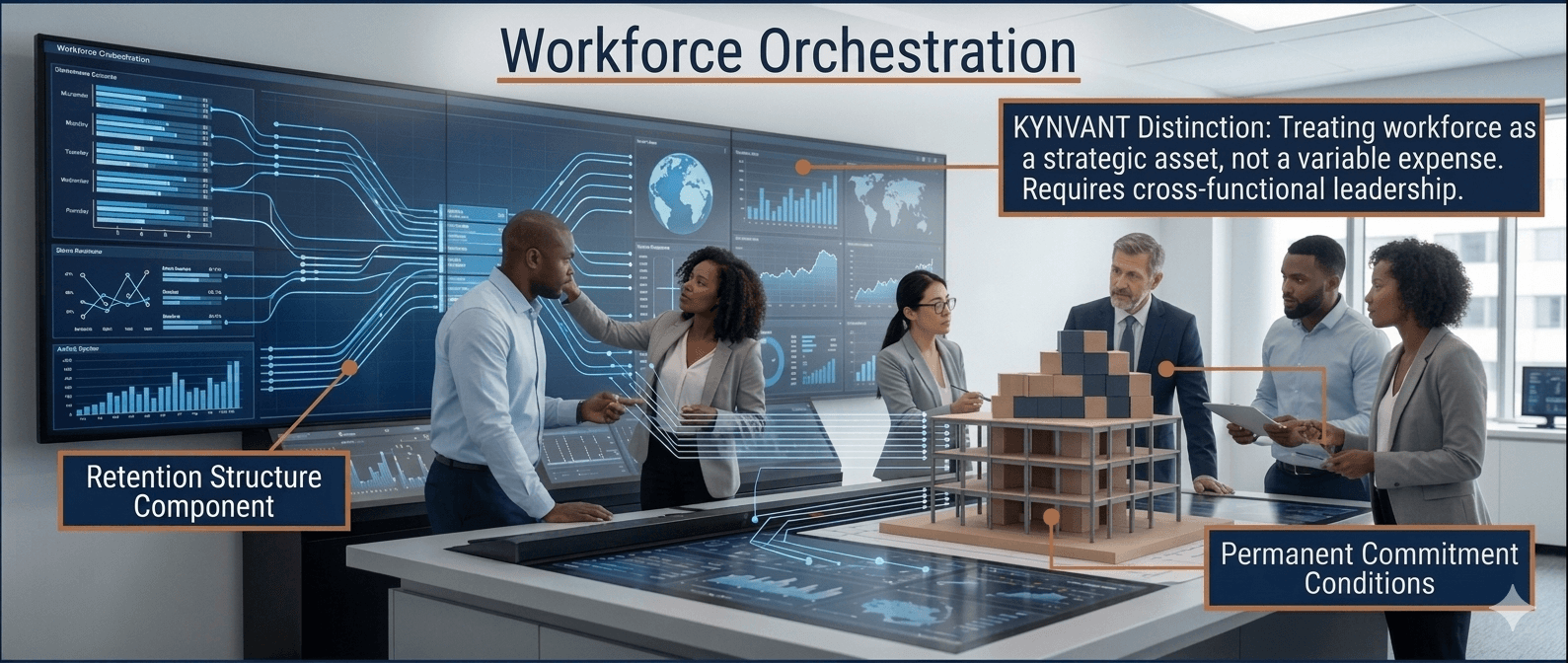
Workforce orchestration operates at a different level of the problem. It begins not with the open shift but with the organizational question underneath it: why does this vacancy exist, what will it cost to leave it unfilled or improperly filled, and what is the right structural solution — not just for today, but for the workforce the organization needs to operate at in three years.
From that foundation, orchestration coordinates the full range of workforce acquisition activity — direct hire, contract-to-perm conversion, embedded recruiting infrastructure, pipeline development, compensation benchmarking, and retention strategy — into a coherent program designed to reduce dependency over time, not extend it. The goal is not coverage. The goal is organizational capability.
The distinction shows up clearly in how success is measured. Staffing measures fill rate. Workforce orchestration measures something harder and more valuable: the trajectory of permanent workforce stability, the declining cost of clinical labor over time, and the compounding clinical and financial returns that come from teams that stay.
Why It Matters Now
The health systems pulling ahead on workforce stability are not the ones with the best vendor relationships. They are the ones that have reframed the problem at the executive level — from procurement to strategy, from coverage to capability, from staffing to orchestration.
That reframing does not eliminate the need for flexible labor in the short term. It changes what flexible labor is for. Used correctly, contract arrangements are a bridge — a tool deployed while the permanent workforce is being built, not a permanent substitute for building it.
The organizations that understand this distinction are making different investments, asking different questions of their partners, and measuring their progress against a different standard. The result is a workforce that compounds in value rather than one that requires perpetual reinvestment to hold in place.
Orchestration is not a new service. It is a new standard for what clinical workforce strategy should produce — and the health systems that adopt it are not looking back.